
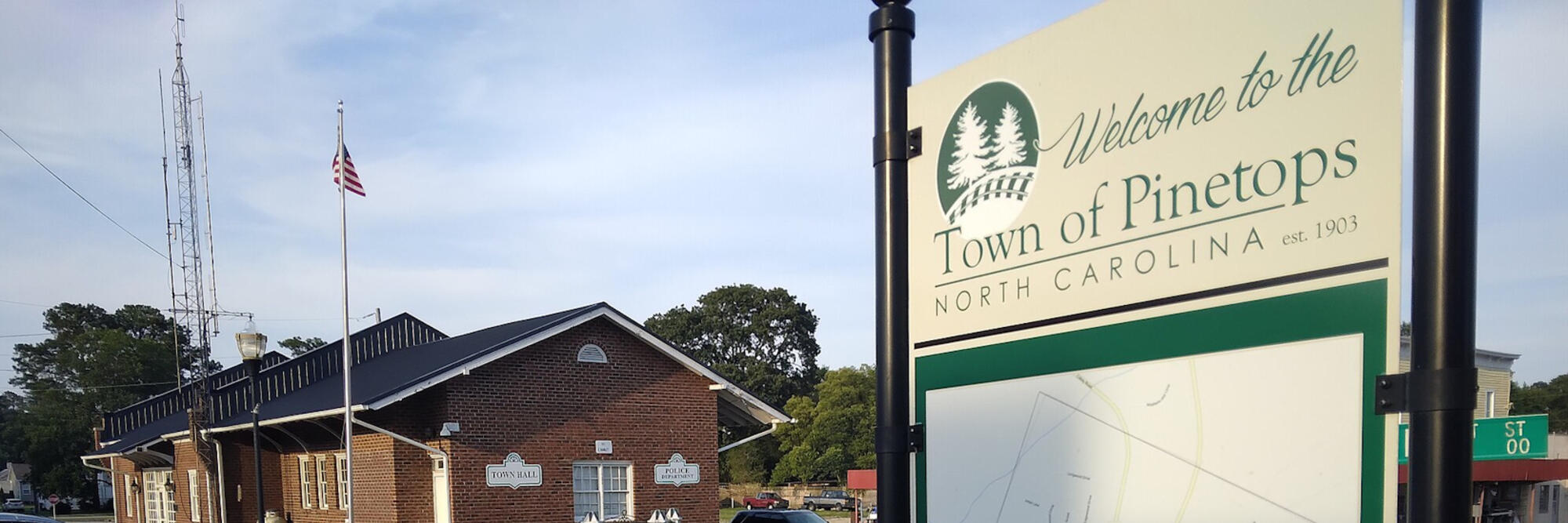
Moving to Pinetops means settling in a small Edgecombe County town in eastern North Carolina, one that took its name from the view out of a passing train window; early travellers could see nothing of the surrounding forest but the tops of the pines. The town was founded in 1901 and incorporated two years later as a rail stop.
Around 1,200 people live here, and the whole town is about one square mile (2.6 sq km) in size. Rocky Mount is roughly twenty minutes away, Greenville is about thirty, and the Raleigh-Durham area is some 60 miles (97km) west. Most newcomers arrive because of that geography rather than the town itself. There’s a grocery shop and a pharmacy to cover the basics in Pinetops, but anything more involved means a drive.
Cost of living in Pinetops
The cost of living in Pinetops is low by state and national standards, and housing is where you’ll notice it most. Homes here are priced well below both the North Carolina and the US median, and it’s the single biggest reason people look at the town at all.
Heating bills are low, but summer air conditioning is a real cost, and July is usually the most expensive month for power. The town runs its own electric utility, and its residential rates are above the state average, so you’ll need to spend some of your housing savings on power. Almost everyone here drives a car, and fuel takes a bigger share of the budget than it would in a city.
North Carolina charges a flat state income tax, and legislators have cut the rate repeatedly over the past decade, so newcomers from New York or California will feel the difference. Edgecombe County property tax rates are high by North Carolina standards, but because home values are low, the bills themselves are modest.
Out-of-pocket healthcare costs are the thing to plan for. There are fewer providers here than in the cities, and you will likely need to drive to Greenville for a specialist. Sort out cover before you arrive, through an employer plan or the federal marketplace, because paying as you go for anything beyond routine care is expensive in the US.
Getting around in Pinetops
Getting around in Pinetops typically means driving, and you will likely need a car from the first day. NC 43 is the main road through town, northwest to Rocky Mount and southeast to Greenville. NC 42 is the western route towards Wilson. Drivers pick up I-95 and US 64 at Rocky Mount, with US 64 being the quick route into Raleigh.
The town has no bus network of its own. Tar River Transit, which the City of Rocky Mount operates, runs a rural service across Edgecombe and Nash counties on weekdays, and Pinetops is inside the area it covers. This is a demand response service rather than a fixed route, so you buy a ticket in Rocky Mount and book your trip by phone the day before. Most people use it for a medical appointment or a shopping run rather than a daily commute.
Pitt-Greenville Airport is about half an hour away, although the only scheduled service is the American Airlines route to Charlotte. For longer trips, you will likely head to Raleigh-Durham, roughly an hour and a half west.
Useful links
- Tar River Transit: Rural General Public Programme
- Pitt-Greenville Airport
- NCDOT: Driving and Licensing
Healthcare in Pinetops
Healthcare in Pinetops is essentially one clinic, which is more than most towns of this size manage. ECU Health, the largest health system in eastern North Carolina, runs a family medicine practice here that covers routine and chronic care, along with same-day appointments for minor problems.
For an emergency, the nearest hospital is ECU Health Edgecombe in Tarboro, about 12 miles (19km) away, and its emergency department is open around the clock. Greenville is where the more serious medicine happens. ECU Health Medical Center in Greenville is the region’s main referral hospital and has Level I trauma centres for adults and children.
Understanding Health Insurance in the USA
Useful links
Schools in Pinetops
The schools in Pinetops are run by Edgecombe County Public Schools. G.W. Carver Elementary is in the centre of town, and South Edgecombe Middle and SouthWest Edgecombe High are both a short drive away. Academic results are worth looking at closely. Proficiency scores across the district are below the North Carolina average. The district provides for children with additional needs through its Exceptional Children services.
There are no private schools in Pinetops itself. Rocky Mount Academy is the main independent option within reach, and there are a few other private schools in the county that are religiously affiliated and teach the standard American curriculum. Families who want an international curriculum, such as the IB, will not find one in Edgecombe County, and Raleigh is the closest place to look.
Useful links
Weather in Pinetops
The weather in Pinetops is humid subtropical, which means long hot summers and short mild winters. From June to August, highs average around 90°F (32°C), and you will feel the humidity on top of that. Afternoon thunderstorms are common through the summer and usually pass quickly.
Winter is December to February, and average lows are around 34°F (1°C). Snow falls occasionally but rarely settles for long, and although hard freezes do happen, they seldom last more than a day or two.
The part of the year to plan around is hurricane season, from June to November. Pinetops is far enough inland that wind damage is less of a concern than on the coast, but the rain is another matter. Hurricane Matthew in 2016 and Hurricane Floyd in 1999 both severely flooded parts of Edgecombe County. Check the flood position of any property before you commit, and ask about flood cover separately, because standard US home insurance does not include it.
Working in Pinetops
Working in Pinetops typically means working somewhere nearby. Greenville is the biggest draw, largely because of East Carolina University and ECU Health, and the drive is about half an hour. Rocky Mount has distribution and food manufacturing, and the Research Triangle is within reach for anyone prepared to spend an hour on the road each way. Teaching and healthcare are the fields that recruit most consistently across the area.
Inside the town, manufacturing is the mainstay. ABB has run a plant just outside Pinetops since the late 1970s and makes components for the electricity grid there. Cotton Belt has made mattresses and furniture here since the 1930s and sells under the Sleepworthy and Therapedic names.
Useful links
Accommodation in Pinetops
Accommodation in Pinetops is affordable by any American standard, and most of it is single-family housing on generous lots. A mile outside the town limits, you get into farmland and much larger plots.
Given the size of Pinetops, real estate agents and residents talk in terms of streets instead of neighbourhoods. South Second Street and North Main Street are the established residential addresses, and the housing stock there is mostly older single-family homes in a range of styles. Families with young children often look at the streets near G.W. Carver Elementary, which is central and within walking distance of the shops.
Buyers are mostly looking at existing stock. Rentals are scarce, and tenants have little to choose from, so allow yourself time. Inside the town limits, the town supplies water, sewer, electricity, and rubbish collection on a single bill. On the larger plots outside, you are usually on a private well and septic tank, so budget for inspections.
Lifestyle in Pinetops
Lifestyle in Pinetops is small-town by definition, and you will likely drive for most of what you want. Tarboro is the nearest place for a proper meal out, or a browse round the shops, and its historic district is pleasant enough to make an afternoon of it. Rocky Mount has cinemas and chain restaurants, and Greenville has the bars and live music of a university city.
The Centennial House is the town’s local history museum, in a house built in 1912. Tarboro and Rocky Mount both have museums worth the short drive, and so does Princeville, which is the one to make time for. Freed formerly enslaved people settled Princeville just after the Civil War, and it is recognised as the oldest town in the United States chartered by Black Americans.
Maccripine Country Club is just outside town and has an 18-hole course and a driving range, along with a separate pool membership that families use over the summer. The Tar River is a few minutes north and is the main outdoor draw for canoeing and fishing.